
Jackson County Projected Versus Actual Release
Oregon Department of Corrections calls its forecast the projected release date, or PRD. The date is based on the legally operative sentence, how grouped terms are treated, and credits that apply at the time of calculation. It can move. The physical exit date is recorded after the event, while final discharge from parole or post-prison supervision may occur much later. Keeping those events apart prevents a forecast from being reported as a completed release.
A person awaiting trial does not have an ODOC PRD merely because the current Jackson County roster includes a Release Date column. Bail, recognizance, dismissal, a court order, an unresolved hold, or transfer can govern that county episode. A sentenced local jail term also uses the judgment and sheriff's implementation, not the state prison search field.
- Projected release date
- ODOC's present forecast for leaving physical prison custody.
- Actual release
- The documented custody change at the time it occurs.
- Discharge
- The later formal end of parole, probation, or post-prison supervision.
- Detainer
- A hold or request from another authority that can affect where a person goes next.
Find a Jackson County Projected Release
Start by deciding whether the person is in Jackson County Jail, an ODOC prison, a community-corrections placement, or another agency's custody. The tools are not interchangeable. For state custody, the Oregon Offender Search accepts first, middle, or last name and SID. The documented wildcard syntax can help with partial names. Compare SID and month and year of birth, then open Names, Offenses, and Print. Location, Status, Caseload, sentence dates, and PRD must be read together.
For a county jail episode, check the controlling Jackson Circuit Court judgment and ask the sheriff for the actual release or transfer date, time, reason, authority, and destination. A roster absence does not answer “release to where?” Jackson County's prison-transfer page says an ODOC transfer may occur within one day or take weeks. A move out of county custody can therefore lead to state, federal, or other custody rather than the community.
- Identify the custodian and collect the full name, date of birth when lawfully known, SO number, SID, and court case number.
- For an ODOC case, search by SID when possible and inspect the matching record's Status, Location, Caseload, offense data, and PRD.
- For a county term or pretrial hold, obtain the judgment and ask Jackson County Sheriff's Criminal Records for the release or transfer event.
- If a Board parole decision applies, request the Board Action Form or final order. Do not assume every prison sentence has a parole hearing.
- After the date passes, verify the actual event with ODOC, the sheriff, and the relevant court or supervision record.
The official OOS help page shows how the state search is scoped and labeled.

The captured help view supports use of OOS for current custody or community-corrections records, not as a complete historical archive of Jackson County releases.
Note: Prefer the Oregon SID over a name-only match because the same name may belong to more than one person.
Jackson County ODOC Release Fields
OOS can expose much more than one date. Public identity fields may include a photo, SID, names or aliases, age, month and year of birth, gender, race, and physical descriptors. Custody fields may include Status, Location, and Caseload. Offense and print views can show the docket number, county, crime, sentence type, begin date, termination date, and termination code.
Each item answers a narrow question. A prison Location supports present physical custody. A Jackson Community Corrections Caseload can support physical release under supervision. An offense Termination Date may concern one sentence component rather than full release or discharge. PRD remains a forecast. When old or certified details matter, use ODOC's Public Records Center and ask for the final face sheet, admission and release data, computation history, order of supervision, and discharge record.
| Field | What it can establish | Limit |
|---|---|---|
| Status and Location | Current ODOC custody or placement context | Periodically updated public data |
| Caseload | Possible local Community Corrections supervision | Not final proof of discharge terms |
| Projected release date | Current state prison forecast | Can change and is not actual exit |
| Termination date/code | End or disposition of an offense component | Not always person-level release |
| Docket and county | Links the sentence to a court case | Court file supplies the controlling judgment |
Oregon Earned Time for Jackson Releases
ORS 421.121 allows reductions for qualifying felony sentences tied to crimes committed on or after November 1, 1989. The statute connects credit to appropriate institutional behavior and participation in adult basic-skills development. Combined credits may not exceed 20 percent of the total DOC institutional term and cannot reduce actual prison confinement below six months. Credits may be granted, retracted, or restored under DOC rules.
The maximum is not a promise. The law excludes sentences governed by listed provisions, including ORS 137.635, 137.700, 137.707, 163.105, 163.107, and 163.115. A person-specific calculation can also reflect sentence grouping, credit history, court corrections, and Board action where applicable. Never subtract a flat percentage from the pronounced term to publish an individual date.
Oregon does not have a general “serve 85 percent” rule. Measure 11, chiefly ORS 137.700, sets mandatory minimum terms for listed crimes, and those terms are excluded from ORS 421.121 earned time, subject to limited statutory paths such as ORS 137.712 for specified convictions and findings. The actual statute and judgment are the proper sources.
Note: The 20 percent figure is a statutory ceiling for qualifying terms, not an automatic credit or a personal release calculation.
Why Jackson County Release Dates Change
A PRD can change while the legal record is corrected or administered. ODOC's sentence-recalculation material says the date shown in OOS updates after recalculation. Credits can be earned, withdrawn, or restored. A corrected judgment can alter the operative term. Concurrent sentences run together under the judgment, while consecutive sentences run one after another. Their treatment affects the projected endpoint.
Custody timing can also differ from final sentence discharge. ODOC notes that certain eligible people may leave physical custody 30, 60, 90, or 120 days early through short-term transitional leave. That placement does not necessarily end the sentence. A detainer may shift a person to another custodian. Board action can change dates in an eligible parole case, and misconduct can lead to postponement.
| Change | Effect on the date or event |
|---|---|
| Credit granted, retracted, or restored | ODOC recalculates the PRD under the applicable rules. |
| Corrected or amended judgment | The legally operative sentence changes. |
| Consecutive or concurrent treatment | Terms are grouped differently. |
| Board action or postponement | An eligible parole date may be set, affirmed, deferred, or moved. |
| Detainer or transfer | County or state custody may end while another authority takes custody. |
| Transitional leave | Physical placement can change before final sentence discharge. |
Jackson County PRD Recalculation Alerts
The ODOC sentence-recalculation FAQ confirms that PRD appears in OOS and updates after a recalculation. VISOR has also warned that an Oregon Supreme Court opinion may change some projected dates and says registered users receive change notifications. These notices are a reason to recheck the source, not proof that an individual has been released.
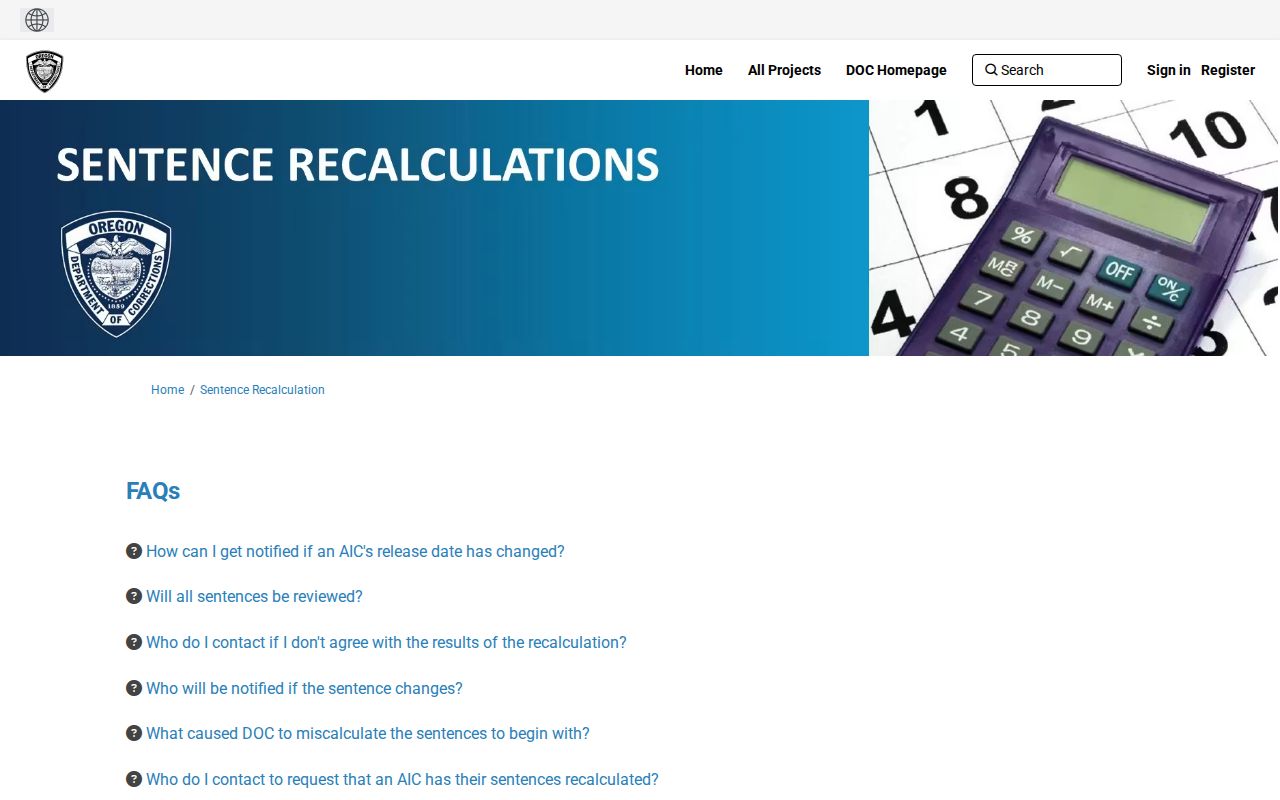
The captured ODOC material shows why a saved result may become stale. Record the date observed and revisit OOS after a known recalculation.
VISOR may send a release, transfer, or date-change alert when the relevant agency data are available. It remains a notification tool. The Jackson County VINELink inmate search page explains present VISOR registration and the county's older VINE phone workflow.
Jackson County Jail Release Authority
County jail dates follow a different path from ODOC calculations. A pretrial person may leave on bail or recognizance, after dismissal or non-filing, or under another court order. A local sentenced person may complete the term as implemented by the sheriff. Jackson County's special-pass and early-release instructions state that only the sentencing judge can grant such relief. Jail staff do not have that authority.
Capacity release is also distinct. ORS 169.046 permits sheriff action under an adopted capacity emergency plan with notice. Such a release is not an acquittal, dismissal, or completed sentence. The authority and destination belong in the person-level release record.
When precision matters, use the Jackson County public-record request form to ask Sheriff's Criminal Records for the actual date and time, type or reason, authority, and receiving agency if transferred. Pair that record with the court judgment. For a possible state transfer, allow for processing and search OOS. The full Jackson County released-inmate record process addresses the custody path after a name leaves the current roster.
Note: A Jackson County roster disappearance can mark transfer, so it cannot substitute for an actual release or destination record.
Confirm Jackson County Actual Release
After a projected date arrives, check the record nearest the event. For a county jail exit, use the sheriff's release or transfer entry. For a state prison exit, use ODOC's actual release record. A court judgment supplies the legal sentence but usually not the exact door time. A Board Action Form supplies the parole decision in an eligible case but does not stand in for the later physical event.
If OOS still lists a prison Location, the person remains shown in custody. If it lists a Jackson Community Corrections Caseload, physical release may have occurred while supervision continues. If the person is absent, request historical records because OOS does not promise a complete former-offender archive. Label the PRD, actual exit, supervision start, and discharge date separately.
An ODOC request should identify one person by full name and SID and state which date is needed. Ask for the admission and actual release dates, release type or destination, PRD computation and changes, the order of supervision, and the final discharge record. Request certification at submission if formal proof is needed. For an old Jackson County case, a public pen pack may contain first and last face sheets, court or sentence orders, a public-information print, and applicable parole or discharge material. That record set can resolve a date after OOS no longer returns the person.