
Jackson County Parole or Probation
Parole and probation can both require reporting, but they begin through different legal paths. Probation is a sentence or condition ordered by a court, often instead of a prison term or after a local jail term. Parole applies to a narrower class of Oregon prison cases in which the Oregon Board of Parole and Post-Prison Supervision has release authority. Post-prison supervision is the supervised period that follows many determinate prison sentences. Jackson County Community Justice Adult Services handles local parole, probation, and post-prison supervision work.
A person may be out of physical custody yet still have a Community Corrections caseload. That is why the word “released” must be qualified. Released from jail or prison describes a custody change. Discharged means the legal supervision term has ended. The sentencing judgment, order of supervision, or Board Action Form is stronger evidence than a name disappearing from a current roster.
| Record type | Who orders it | Best verification |
|---|---|---|
| Probation | Oregon circuit court | Judgment, later court orders, and Jackson County Community Justice |
| Parole | Oregon Board of Parole and Post-Prison Supervision in an eligible case | Board Action Form, final order, OOS status, and local supervision office |
| Post-prison supervision | Sentence and Oregon law after prison | ODOC record, court judgment, order of supervision, and local caseload |
- Parole
- Conditional release from prison in a case governed by Board authority.
- Probation
- Court-ordered supervision in the community.
- Post-prison supervision
- A supervised term after physical release from prison.
- Discharge
- The formal end of supervision, which is later than physical release.
Verify Jackson County Post-Release Supervision
Begin with identity and the most likely legal path. The Oregon Offender Search accepts a first, middle, or last name and an Oregon SID. Its help also permits wildcard name searches. Results can show Status, Location, and Caseload. A Jackson Community Corrections caseload can support that the person has left prison but remains supervised. OOS is periodically updated, is not an official record, and covers current ODOC custody or current local Community Corrections. It is not a full list of everyone once supervised.
Use the local office and controlling order to resolve the result. A no-result outcome might mean full discharge, a spelling mismatch, or that the person falls outside OOS scope. It is not proof by itself. The court judgment explains probation. A Board final order explains an eligible parole decision. ODOC former-offender records supply historical admission, release, supervision, and discharge facts after a person leaves the public OOS scope.
- Search OOS by SID when known. Otherwise use the full name or the documented wildcard form and compare month and year of birth.
- Open the matching record. Read Status, Location, and Caseload together instead of relying on a name alone.
- Check the Jackson Circuit Court judgment for probation terms, modifications, revocation, or discharge.
- For an eligible parole case, request the Board Action Form or final order by name, SID, hearing date, and hearing type.
- Ask Adult Services only for public office or status information it may lawfully confirm. Request an ODOC historical record when current tools no longer show the person.
Note: A Community Corrections caseload supports supervised release, but the official order controls the type and duration of supervision.
Jackson County Supervision Intake Office
Jackson County Community Justice provides the local intake route. After a Circuit Court sentence or an interstate or jurisdiction transfer, the person meets a duty officer, completes intake paperwork, and receives an officer assignment plus a report-back date. The county says a person on basic supervision who has just left custody must report immediately in person. Enhanced supervision can add assessment, contacts, visits, referrals, and case planning based on the controlling terms.
The office is a verification point, not an open case-file database. Staff may limit details about an officer assignment, residence, conditions, or notes. Ask for public confirmation tied to the legal order, then use the court or Board record for formal terms.
Jackson County Community Justice Adult Services1101 W. Main St., Suite 101
Medford, OR 97501
541-774-4900
Monday through Friday, 8 a.m. to 5 p.m.
Front office: 541-774-4990; closed noon to 1 p.m. per the intake page
The county's adult intake and supervision page shows the local reporting route.
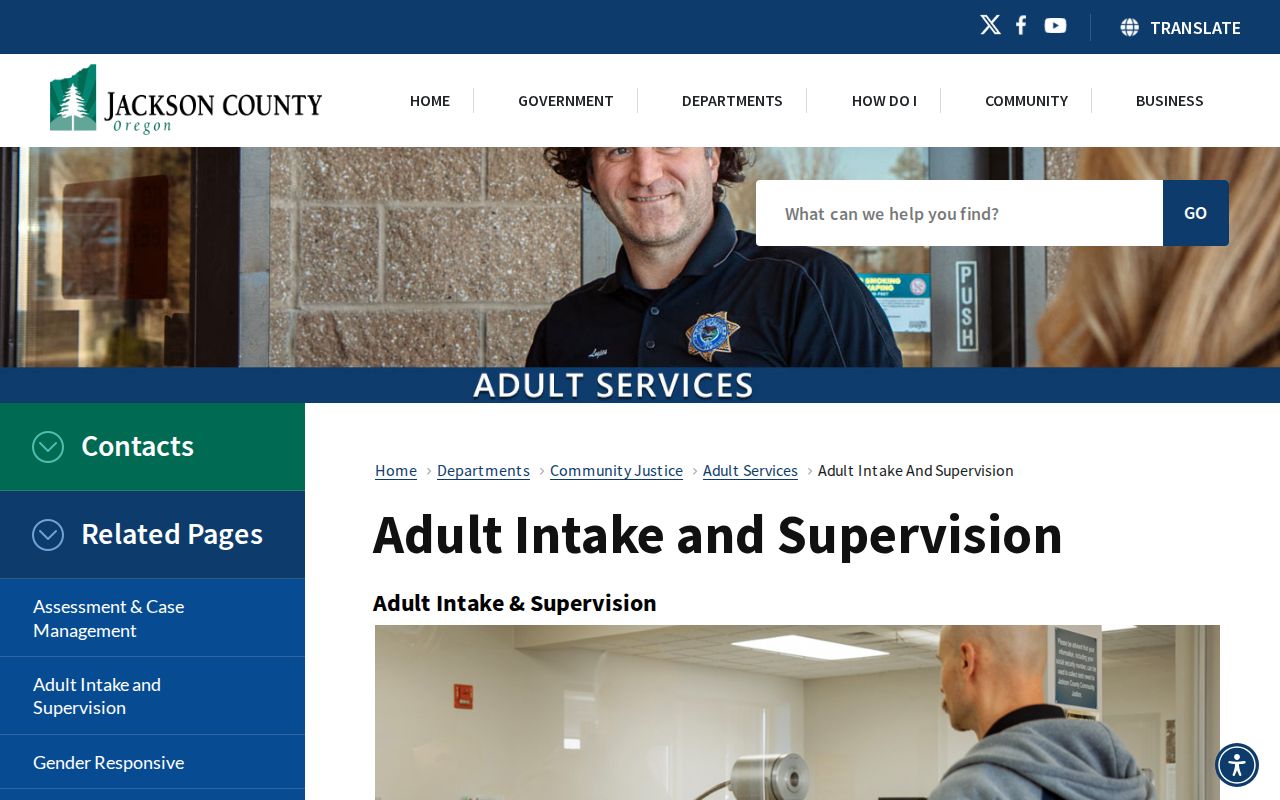
The captured intake page connects a released person's immediate report to the Jackson County office that assigns local supervision.
Jackson County Release Support Path
Jackson County has a locally distinct bridge from prison to community supervision. Community Justice describes a pre-release reach-in process that can begin before the prison exit. Staff discuss assessment, plans, resources, and supervision expectations. That early contact helps explain why a Jackson caseload can appear soon after physical release.
The county also operates a 139-working-capacity Transition Center. It is a structured community-corrections facility, not another sheriff jail and not a recent-release list. A person who completes or leaves the program may return to the community while supervision continues. Confirmation comes from Community Justice and the court or Board order that governs the placement.
An onsite Adult Services Resource Center can start requests for Oregon identification and Social Security card replacement and can help restore Oregon Health Plan or food-assistance access. Those service facts do not prove supervision status. They show how Jackson County connects release planning, local intake, a structured placement, and practical documents.
Property After Jackson County Release
Release or transfer can leave a document problem that affects the first supervision report. Jackson County Jail generally holds personal property until release. If someone transfers to state or federal custody, items that cannot travel may be released to a named recipient with authorization. The county warns that property left after such a transfer is treated as abandoned after 72 hours. Even a driver license may remain behind.
The distinction matters when a person must report to Adult Services at once. A transfer out of the jail is not the same as a community release, and the property rule does not state the person's supervision status. Use the sheriff transfer record to identify destination, then the OOS caseload or controlling order to establish supervision. The Resource Center may assist with replacement documents after release.
Note: Property pickup and supervision verification are separate tasks, even when both become urgent on the day custody changes.
Jackson County Violations and Absconders
Conditions depend on the judgment, Board order, and supervision plan. They may require reporting, approved travel, treatment, or other conduct. A violation allegation does not itself show the final outcome. The officer, court, or Board may use a structured response, seek a warrant, modify conditions, or begin revocation proceedings. The public court or Board order is the right source for the resulting legal action.
An absconder is a person alleged to have stopped reporting or whose location is unknown while supervision remains active. It does not mean discharge. ODOC's Most Wanted page is a selected list of escapees and failures to appear, not a full Oregon or Jackson County supervision search. Absence from that page has no verification value. Current safety emergencies belong with 911; ODOC lists 877-831-0389 for tips.
VISOR can provide alerts for some custody, parole, or probation changes, but a notification is not the final order. Verify a warrant or revocation through the responsible agency and court record. Avoid inferring status from social media, a roster absence, or an unverified name match.
Jackson County Parole Board Records
The Oregon Board publishes a dynamic hearings calendar. It is a schedule, not a person-name decision database. Different hearing types answer different questions. A Prison Term hearing may set or decline to set a projected parole date. An Exit Interview may affirm or defer a projected date. A parole postponement can move it. Murder Review and dangerous-offender proceedings use their own legal tests.
Not every release reaches the Board. Many determinate sentences and Measure 11 terms do not use ordinary discretionary parole. Eligibility can depend on the offense, sentence, and date. When a hearing applies, the decision is memorialized in a Board Action Form. No official public name-based results search was located. Use the Board records request and provide the name, SID, approximate hearing date, and type.
Oregon Board of Parole and Post-Prison Supervision1321 Tandem Ave. NE
Salem, OR 97301
503-945-0900
ParoleBoardRecords@paroleboard.oregon.gov
Jackson County Supervision Discharge
Supervision ends through a formal discharge or other controlling action, not merely because the person no longer reports to the same office. A probation discharge may appear in the circuit court file. A parole or post-prison record may be documented by ODOC or the Board. Offense termination fields can relate to one sentence component and should not be treated as the whole person's final discharge without reviewing the record.
Current portals become less useful after final discharge. OOS states that it covers current ODOC custody and current local Community Corrections. A fully discharged former offender may no longer return a result. Request a former-offender record or public pen pack from ODOC for historical release, order of supervision, and discharge documents. The broader Jackson County released-inmate search and record path explains how a sheriff release event and a court disposition fit beside those supervision records.
Note: Physical release, supervision start, offense termination, and final discharge are separate events and may carry four different dates.