
Transition Center Completion Meaning
The Jackson County Community Justice Transition Center is a structured community-corrections facility. It is not an ordinary sheriff jail, and its participants do not form a public recent-release feed. The program serves male and female justice-system clients with transitional and treatment services. A participant may be there as part of a court, parole, probation, post-prison supervision, or Community Justice plan.
Completion usually means movement into the community under whatever legal terms remain in force. It does not necessarily mean final discharge from supervision. A participant may still have an assigned officer, reporting dates, court conditions, or an active state community-corrections caseload. An early departure, transfer, sanction, or other status change also must not be labeled a successful completion without confirmation from the agency responsible for the placement.
This sequence is different from a jail release. The sheriff records a physical exit or transfer from Jackson County Jail. The Transition Center records participation in a structured county program. A court or Board order supplies the legal framework, and Adult Services administers local supervision. One source should not be made to answer all four questions. When speaking with an office, use “program completion,” “departure,” “supervision status,” or “final discharge” according to the event actually sought.
| Status question | Correct source | What it can establish |
|---|---|---|
| Did the participant complete or leave? | Jackson County Community Justice | The program event and public status information the county may release. |
| What legal terms still apply? | Circuit Court judgment or supervision order | Probation, conditions, modifications, or discharge. |
| Was a parole decision involved? | Board Action Form or final order | The Board decision and release calculations for an eligible case. |
| Is state supervision current? | Oregon Offender Search and Adult Services | Status or Community Corrections caseload, subject to official confirmation. |
Verify Jackson County Center Completion
Begin with the legal order that explains why the person entered the Transition Center. A Jackson Circuit Court judgment can establish probation or another court-directed status. Some prison-release matters may also involve an Oregon Board of Parole and Post-Prison Supervision order. The controlling document gives meaning to the center stay and identifies the agency that can confirm what followed.
- Confirm identity using the full legal name, date of birth when lawfully known, court case number, and Oregon SID if available.
- Contact the Transition Center or Jackson County Community Justice and ask for the public completion or departure information it may provide.
- Review the controlling Jackson Circuit Court judgment, later order, or Board Action Form for the placement and remaining terms.
- Search Oregon Offender Search by SID or name for current Status and Community Corrections Caseload information.
- Ask Adult Services to confirm only public supervision or office information. Do not assume private case notes or an officer assignment will be disclosed.
The Jackson County release-record search paths help when the person moved through more than one system. A county jail booking, a later ODOC sentence, and a Transition Center stay describe separate periods. Each agency record must be tied to the right period before a completion or discharge is stated.
Transition Center Records and Contact
The official county Transition Center contact page lists the Phoenix location and describes continuous operation. Ask the center where a narrow completion or program-status inquiry should be directed. Supply identifiers and an approximate intake or completion period. State the precise event sought instead of asking for a participant's full file, which may contain protected material.
Community Justice Transition Center
5505 S. Pacific Highway
Phoenix, OR 97535
541-774-6610
Open 24 hours a day, seven days a week
Jackson County's general public-record form is an additional route when Community Justice directs a requester there. Ask for existing public records sufficient to show the participant's intake, completion or departure date, recorded disposition, and next supervision office, where those fields are disclosable. Request electronic delivery and a cost estimate before fees exceed $25. Oregon public-record law allows exemptions and redactions, so the request should not promise a particular response.
Note: A Transition Center departure date and a final supervision discharge date can be different events held by different offices.
Jackson County Transition Center Statistics
The county reports a 139-person working capacity and gives a useful set of 2025 program measures. Those figures describe the center's work during that named year. They are not the Jackson County Jail capacity, countywide release totals, or a list of particular participants. The 97% figure is labeled successful completion, so it should not be recast as a court success rate or final supervision discharge rate.
The measures show why a program completion record needs its own meaning. Many people can enter and complete services during a year without those events matching adult jail releases. Average stay is a program measure rather than a promised length for one participant. The controlling plan and the person's actual records determine the individual timeline.
The annual values also should not be combined into a guessed daily release rate. Intakes and successful completions describe program flow, while transitional-service days measure services delivered. Average daily population describes use of the center's working capacity. None supplies a named participant's entry date, completion date, or remaining court terms. Only the participant-level agency record and controlling order can answer those questions.
The county's Transition Center overview and statistics provides the source context for these values.
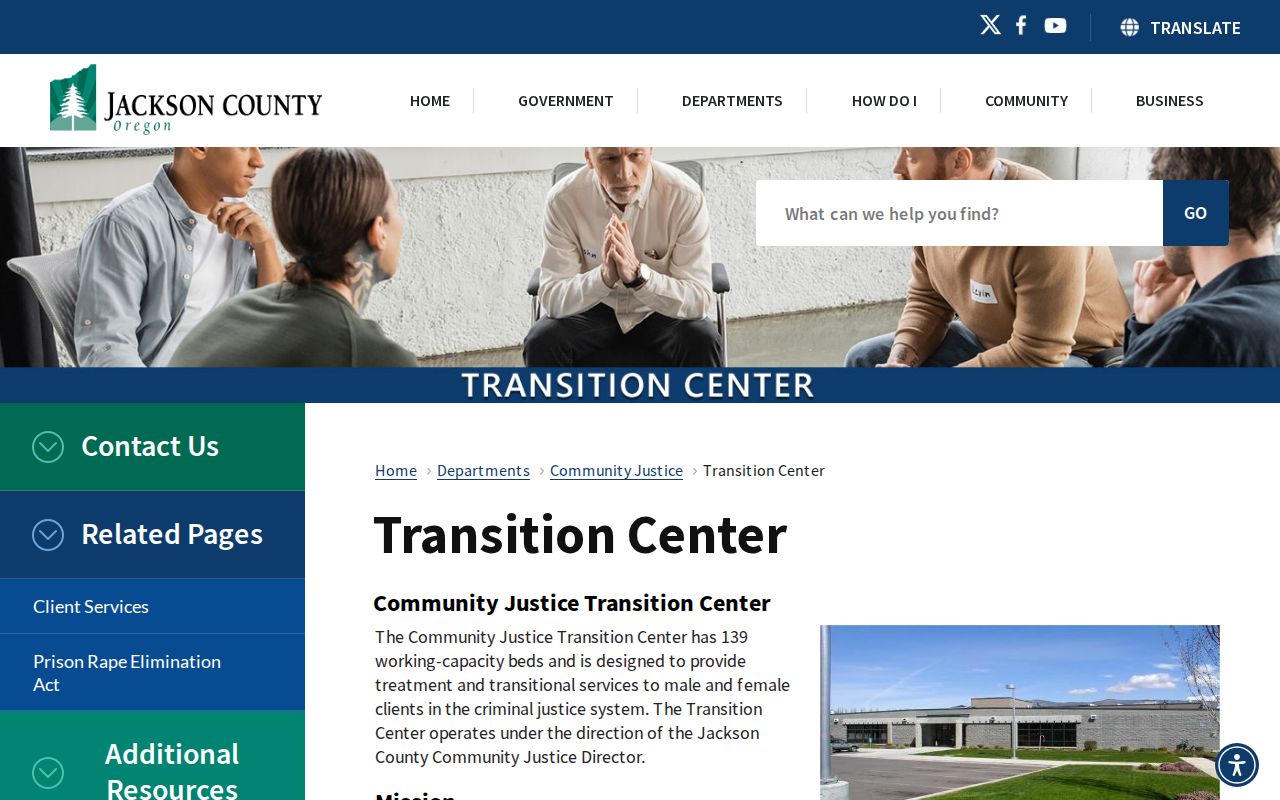
The official overview labels the facility as a Community Justice program and keeps its annual measures tied to structured transition services.
Jackson County Supervision After Completion
Jackson County Community Justice Adult Services administers local parole, probation, and post-prison supervision. Probation generally comes from a court judgment. Parole and post-prison supervision follow a prison sentence under the applicable Oregon legal scheme. Physical departure from the Transition Center does not by itself end any of those legal statuses.
The county's adult intake and supervision process says a person on basic supervision who has just left custody must report immediately in person to the parole or probation officer. At intake, the person meets a duty officer, completes paperwork, and receives an officer assignment and report-back date. Enhanced supervision may involve assessment, contacts, visits, referrals, and case planning. These details explain why a person in the community may still appear with an Oregon Offender Search Community Corrections caseload.
- Probation
- Court-ordered supervision that can exist without a state prison release.
- Parole
- Supervised release used for eligible parole-system sentences and governed by the relevant Board order.
- Post-prison supervision
- Community supervision that follows prison under Oregon's applicable sentencing structure.
- Discharge
- The later end of legal supervision, not merely departure from a facility.
Transition Center Court and Board Records
Jackson Circuit Court records may show the judgment, probation term, later modification, revocation, or discharge order that frames a Transition Center stay. The free Oregon Judicial Department search can locate basic case information. If the online view is thin, newer Jackson documents can be reviewed at courthouse lobby kiosks, while older nondigitized files require retrieval through the Public Room. Request the specific judgment or later order that answers the status question.
A Board case requires a different record. The Oregon Board of Parole and Post-Prison Supervision does not provide a public name-based decision search in the reviewed sources. Its Board Action Form can show the person and SID, hearing or action date, institution, Board action number, and decision or release calculations. Request the BAF or final order using the name, SID, and hearing date. Not every Transition Center participant has a Board case.
When an online status and a legal order appear to differ, label each date. A court order date, center departure date, projected release date, and supervision discharge date can all be valid while describing different stages. The agency record closest to the event should control that event.
Oregon Offender Search is most helpful while ODOC custody or a local Community Corrections caseload remains current. It may show Status, Location, Caseload, names, offense data, and a projected release date when present. It is periodically updated public information, not an official historical certificate. A fully discharged person may no longer appear. In that situation, the relevant court or Board order and a formal agency record request are stronger than an inference from no result.
Jackson County Transition Support Path
The Transition Center sits within a broader local continuity path. Jackson County describes pre-release “reach-in” contacts that connect people with Community Justice before prison release. The Adult Services Resource Center can also begin Oregon identification and Social Security card replacement and help restore Oregon Health Plan and food-assistance access. These services support a move into the community but do not prove completion or discharge.
That distinction is practical. A person may use transition services while still under a court or supervision order. The resource contact, program record, state caseload, and controlling order each answer separate questions. Match the source to the fact and avoid turning service participation into a statement about legal status.